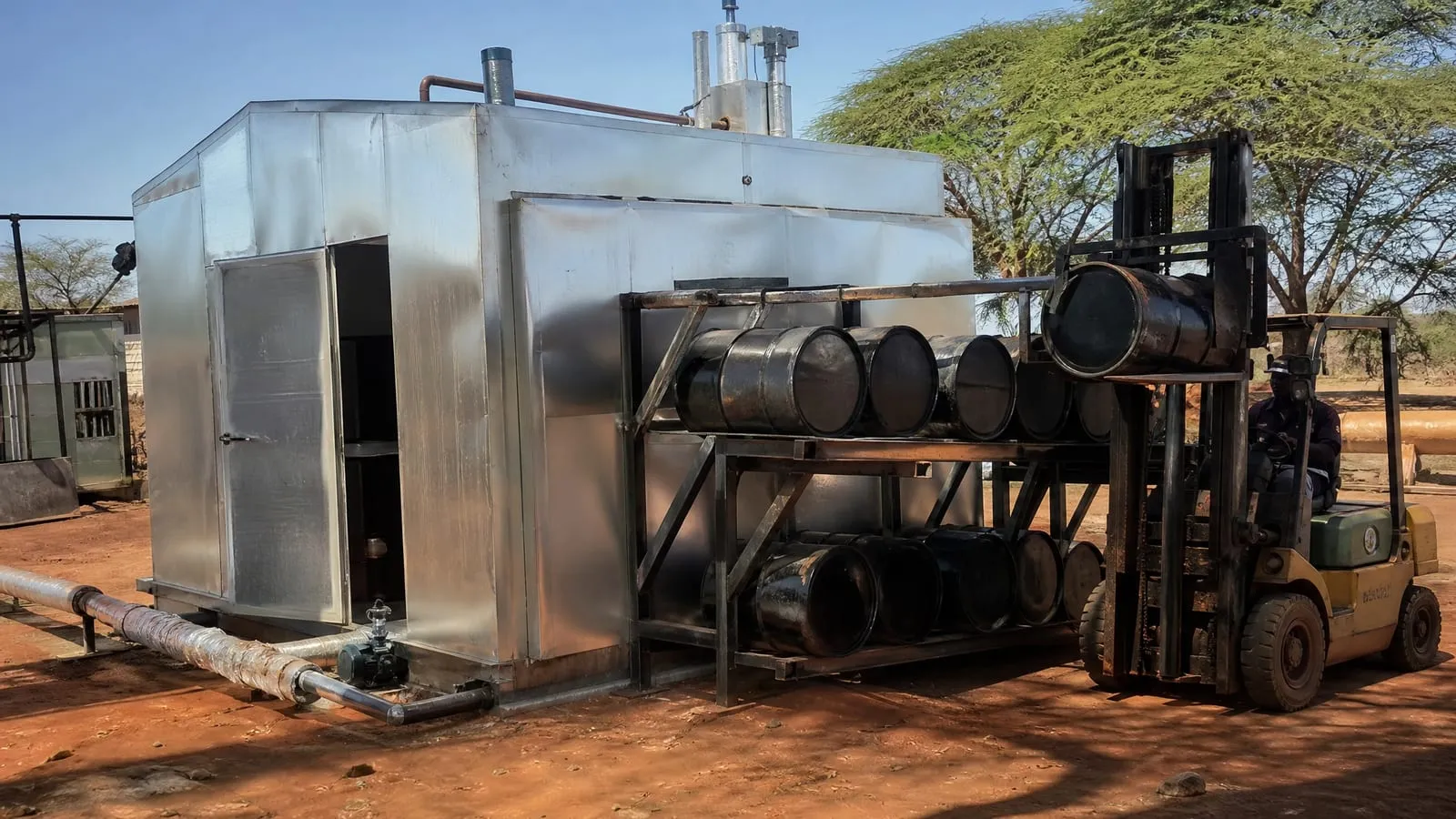
Short answer: A drum decanter heats steel drums of bitumen until it drains into a heated tank, so plants that cannot get bulk tankers still have hot, pumpable binder. Size it to the plant’s daily bitumen use: a plant using 25 t a day needs a decanter that can empty well over 100 standard drums a day. Plan storage, cash and empty-drum disposal too.
Bulk bitumen tankers cannot reach remote districts, inland countries or small islands, and there bitumen often arrives in steel drums.
Bulk vs drummed bitumen
| Bulk (tanker) | Drummed | |
|---|---|---|
| Handling | Pumped straight into heated tanks | Drums unloaded, stored, heated, emptied |
| Cost | Usually lower per ton | Higher: drums, handling, heating |
| Equipment | Heated storage tanks | Decanter + heated receiving tank |
| Site needs | Tanker access; reliable supply | Storage area for full and empty drums |
| Best for | Plants near ports or refineries | Remote sites, irregular supply, small plants |
How a decanter works
- Drums are loaded into an insulated chamber, often with the bung down or opened
- Heat — thermal oil coils, burners or hot gas — softens the bitumen
- Bitumen drains into a heated sump or tank
- A pump transfers it to the plant’s bitumen tank
- Empty drums are removed; the next load goes in
Sizing the decanter
| Plant output | Daily mix | Bitumen at 5% | Daily drum throughput needed* |
|---|---|---|---|
| 60 t/h | about 360 t | about 18 t | about 90+ drums |
| 80 t/h | about 480 t | about 24 t | about 120+ drums |
| 120 t/h | about 720 t | about 36 t | about 180+ drums |
*Assuming roughly 200 kg of bitumen per drum. Check your drum size and the decanter’s melting time per batch.
Melting takes hours, so the decanter must run ahead of the plant, often overnight. Buffer storage in a heated tank keeps production steady.
Supply planning
- Order lead times — drummed supply chains are long; keep weeks of stock where supply is irregular
- Storage — full drums take space; keep them off wet ground and out of the sun where possible
- Cash — stock tied up in drums is money spent before mix is sold
- Labor and equipment — forklift and crew for loading
- Empty drums — store, clean, sell or dispose according to local rules
Safety
- Heat drums only in the decanter, never with open flame directly on drums
- Keep water out — it can make hot bitumen foam violently
- Heat-resistant PPE and burn first aid — see the safety checklist
For storage and heating after the decanter, see bitumen tank heating. Ask us for a decanter configuration.