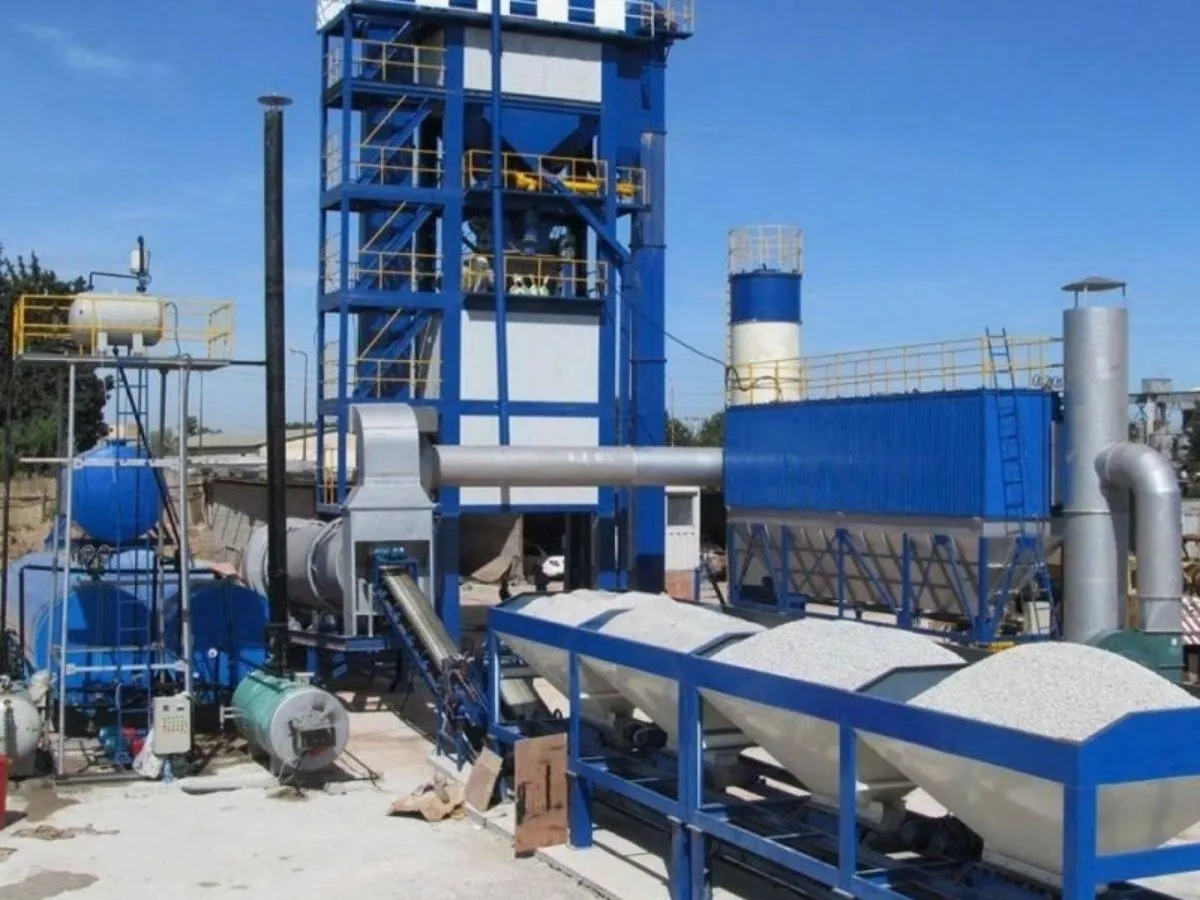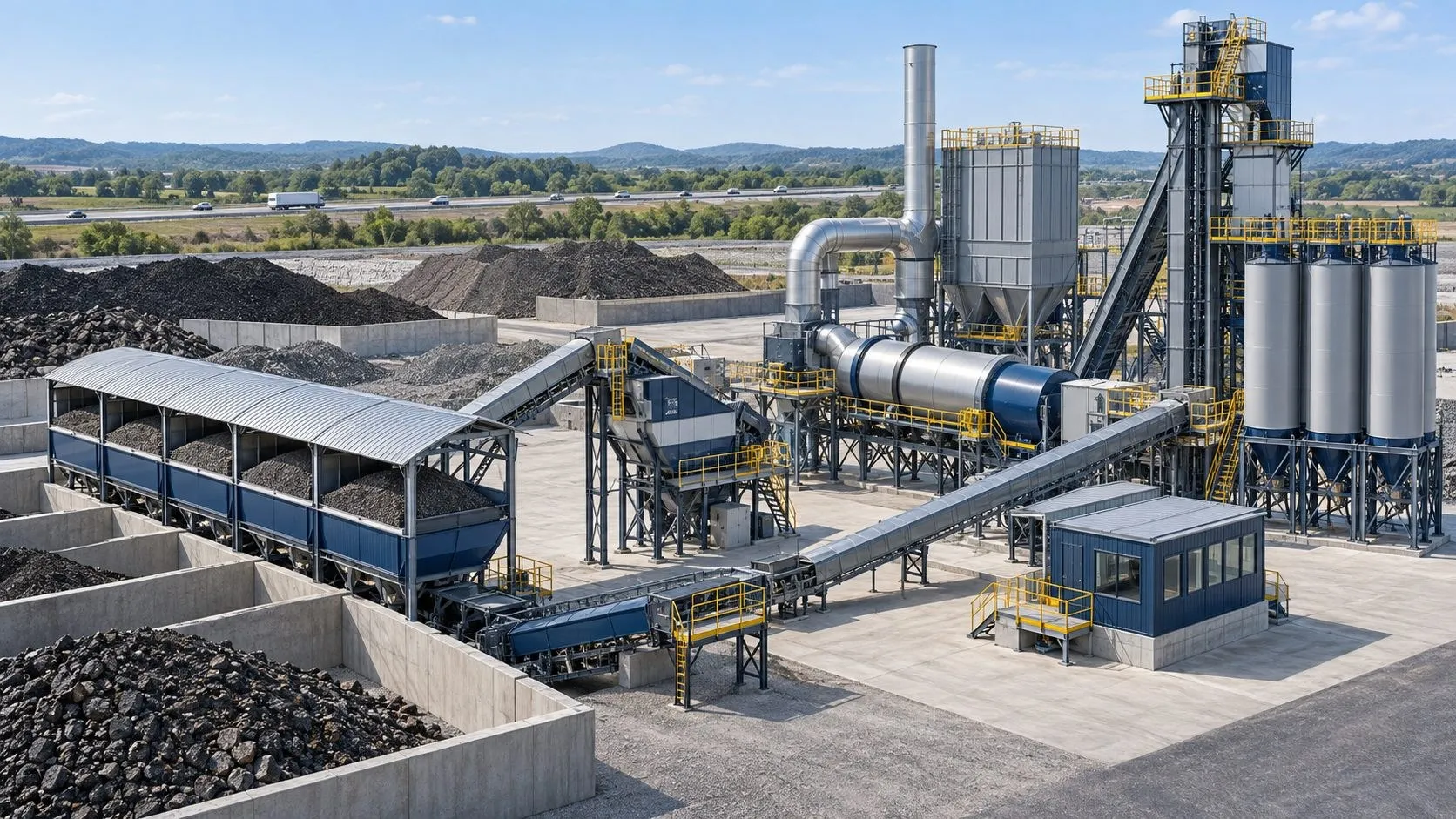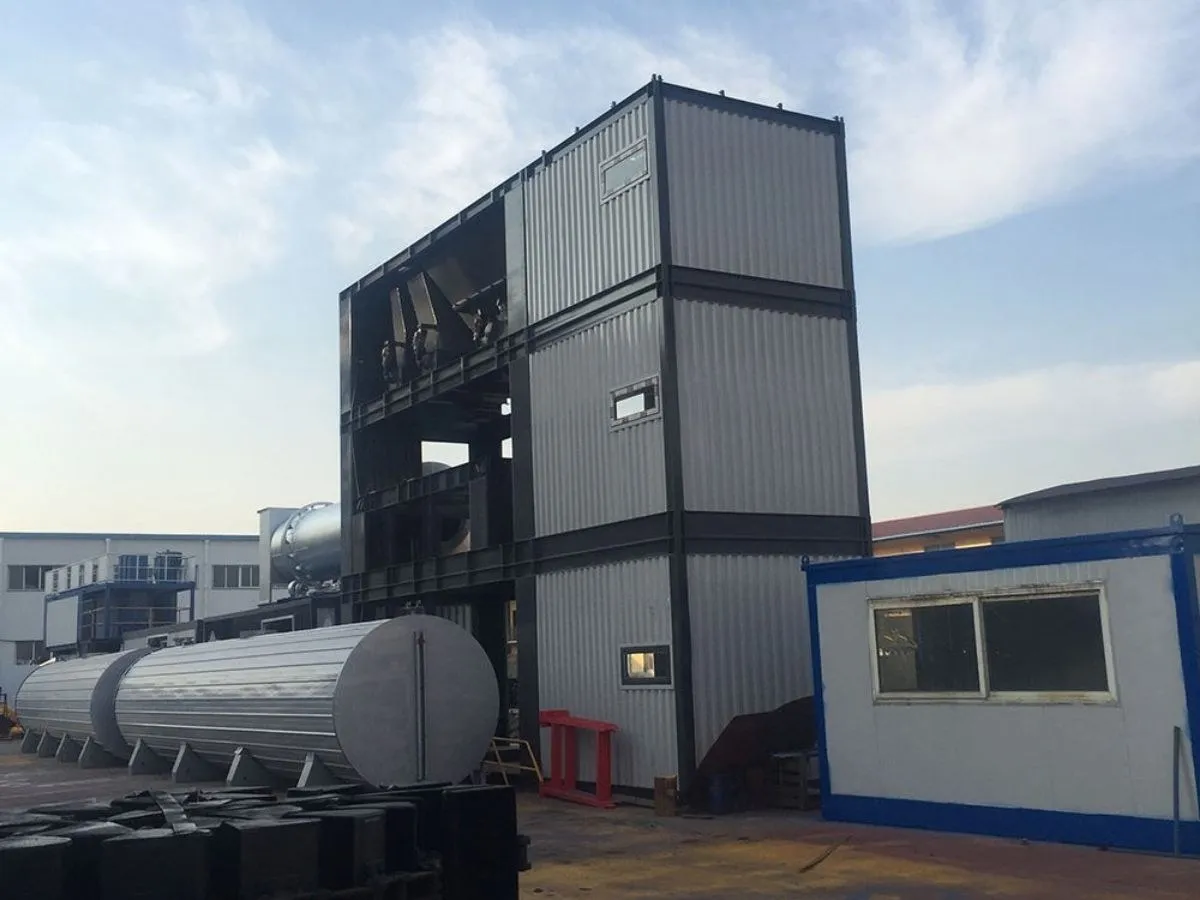
- Containerized
- Batch mixing
- 80–400 t/h
Containerized Asphalt Plant
RMX-C80 ~ RMX-C400
Contractors who move between projects or export plants overseas and still need batch-level mix accuracy.
Asphalt mixing plants and practical support for road projects worldwide

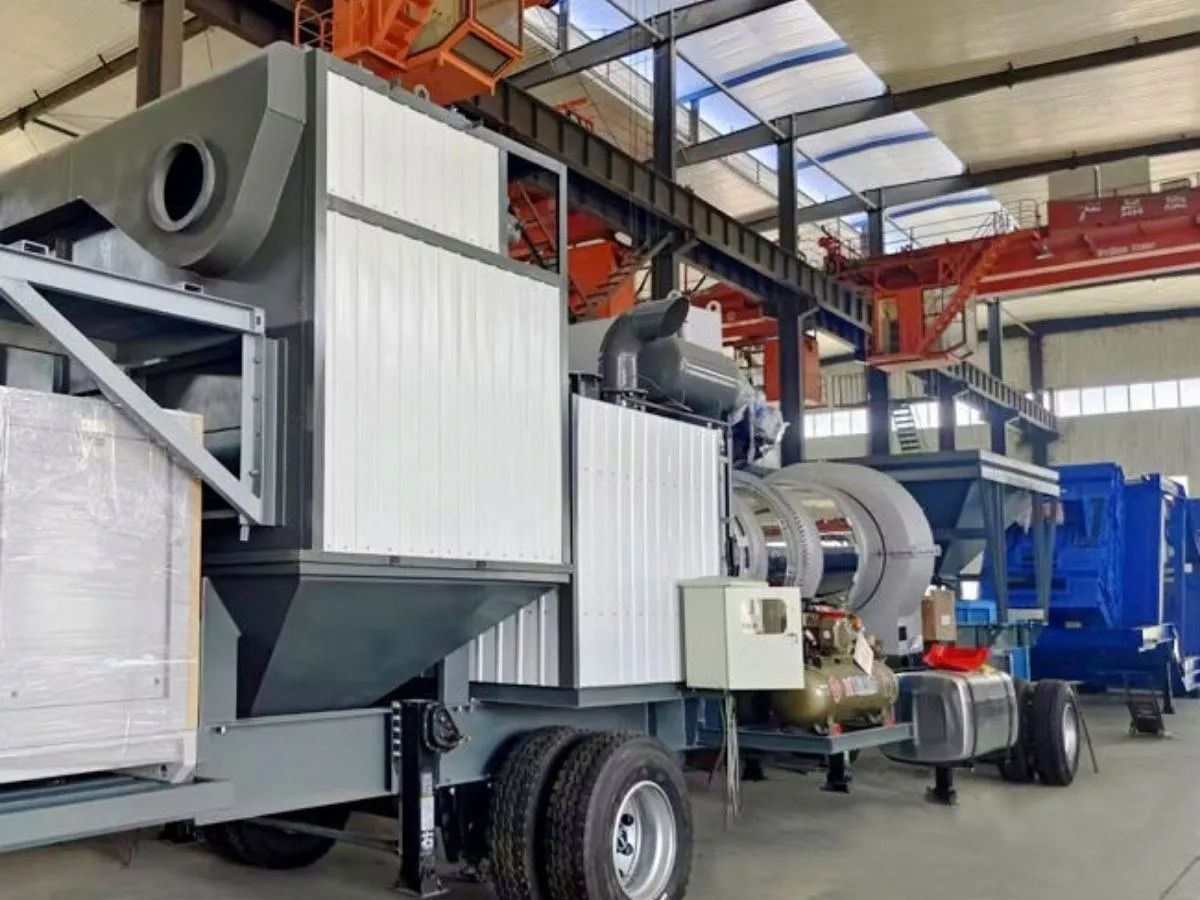
A batch plant whose main units sit on wheeled trailer chassis, so it can be towed to the next job site and producing again quickly.
Best for: Road maintenance and short-term contracts where the plant moves several times a year.
A mobile asphalt plant keeps the batch process but mounts the main units on towable chassis. Instead of dismantling a steel structure, the crew connects the trailers, levels them and links power, fuel and bitumen lines.
Mobile plants earn their keep on work that keeps moving: road maintenance programmes, short contracts in different districts, and projects far from any fixed asphalt supply. Output is lower than the largest stationary plants, so size it to your average daily need.
Check road-transport rules for oversize loads along your routes, and how often you will really move. If moves are rare or the journey is long-distance by sea, a containerized plant may be easier to ship.
The RMX-M groups the plant into a small number of towable units, each with axles, a kingpin and leveling legs:
| Unit | Main components |
|---|---|
| Cold feed trailer | Feed bins with belt feeders and collecting belt |
| Drying trailer | Drying drum, burner and inclined feed conveyor |
| Mixing trailer | Hot elevator, vibrating screen, hot bins, scales and twin-shaft mixer |
| Dust collection | Baghouse with exhaust fan and stack |
| Bitumen and control | Bitumen tank with heating, and the control cabin |
Fewer, larger units mean fewer lifts and connections at every move — the main time saving compared with a stationary plant.
| Model | Rated output | Daily output, 8 h at 75% | Typical work |
|---|---|---|---|
| RMX-M60 | 60 t/h | about 360 t | Town streets, patching and overlay programs |
| RMX-M80 | 80 t/h | about 480 t | District and county maintenance |
| RMX-M120 | 120 t/h | about 720 t | Resurfacing contracts with two paving crews |
| RMX-M160 | 160 t/h | about 960 t | Larger contracts that still move every season |
Choose by the daily tonnage your paving crews and trucks can really place. A plant much bigger than the paving fleet spends its day waiting.
| Question | Mobile (RMX-M) | Containerized (RMX-C) | Stationary (RMX-B) |
|---|---|---|---|
| How it travels | Towed on own wheels | Trucked or shipped as container modules | Shipped as sections, erected once |
| Typical move frequency | Several times a year | Every one to three years | Rarely or never |
| Foundation | Leveled, compacted ground | Leveled, compacted ground | Concrete foundations |
| Output range | 60–160 t/h | 80–400 t/h | 60–400 t/h |
| Best journey | By road, within a region | By sea or long road distances | — |
For a deeper comparison, read stationary vs mobile vs containerized plants.
Burner fuel choice or dual fuel, a small hot mix storage bin, extra bitumen tank, insulation for cold regions, cold RAP addition, and a generator set for sites without grid power.
Indicative FOB prices for RMX-M plants run from about $180,000 to $540,000 across 60–160 t/h. See the model-by-model price page and the price guide for what changes the figure.
Mobile Asphalt Plant — RMX-M60 ~ RMX-M160, 60–160 t/h.
| Model | RMX-M60 | RMX-M80 | RMX-M120 | RMX-M160 |
|---|---|---|---|---|
| Rated output (t/h) | 60 | 80 | 120 | 160 |
| Mixer capacity (kg/batch) | 700 | 1000 | 1500 | 2000 |
| Installed power (kW) | 157 | 241 | 330 | 412 |
| Fuel consumption, oil (kg/t) | 5.5–7 | 5.5–7 | 5.5–7 | 5.5–7 |
| Mix temperature (°C, adjustable) | 130–165 | 130–165 | 130–165 | 130–165 |
| Plant footprint L × W (m) | 35 × 26 | 40 × 28 | 40 × 32 | 42 × 32 |
Configurations can be customized. Ask for a model recommendation →
Every batch is weighed before mixing, so each ton of asphalt meets the selected formula. These are the main systems of the plant, in the order material flows through them.
Four to six hoppers each hold one aggregate size; belt feeders with speed control release them in the ratio your mix design calls for.
The rotating drum tumbles aggregate through the burner flame until moisture is driven off and the stone reaches mixing temperature.
Buckets carry the hot aggregate up to the screen at the top of the mixing tower.
A vibrating screen splits the hot stone into size fractions again, correcting any variation from the cold feed.
Each fraction waits in its own insulated bin so it can be weighed exactly.
Stone, filler and bitumen are weighed per batch, then blended in a twin-shaft mixer before discharge to trucks or a storage silo.
Fabric filters catch the fine dust in the dryer exhaust; recovered fines can be returned to the mix as filler.
A PLC system runs the sequence, stores recipes and logs each batch for quality records.
A mobile plant travels on its own wheels and is towed between sites; a containerized plant ships as container modules. Mobile suits frequent moves by road; containerized suits long-distance or overseas freight and larger outputs.
It is designed for repeated relocation. How often is practical depends on your road network, transport permits and project durations.
Yes. It is a batch plant, so each ingredient is weighed separately for every batch.
Once it arrives on a level, prepared area, connecting the trailers, leveling them and linking power, fuel and bitumen usually takes a few days, followed by burner checks and trial batches. Distance, crane needs for the baghouse or silo, and crew experience change the time.
Most maintenance crews pave a few hundred tons a day. An RMX-M60 or RMX-M80 suits small-town and district work; an RMX-M120 or RMX-M160 suits contractors running several paving crews or longer resurfacing sections.
Usually yes. The chassis units are wide and heavy, so most countries require oversize-load permits and sometimes escorts. Check the rules on your routes before choosing between a mobile and a containerized plant.
Indicative FOB prices for RMX-M plants run from about $180,000 to $540,000 across the 60–160 t/h range; the 120 t/h model is typically around $380,000. See the price guide for details.
Yes. The RMX-M is a batch plant — aggregate, filler and bitumen are weighed for every batch — so it can produce the same mixes as a stationary batch plant of the same output.
Tell us your required capacity, project location and fuel type. Our engineers will recommend a model and send you a quotation.
Chat on WhatsAppA step-by-step checklist for importing an asphalt plant — from route survey and Incoterms to packing, documents, customs and delivery to site.
Compare stationary, mobile and containerized asphalt plants on output, relocation, foundations and shipping — with a 5-question checklist for your project.
RMX-C80 ~ RMX-C400
Contractors who move between projects or export plants overseas and still need batch-level mix accuracy.
RMX-B60 ~ RMX-B400
Asphalt producers and contractors running one site for years, with many mix recipes and strict specifications.
RMX-R80 ~ RMX-R160
Road owners and contractors with a steady supply of milled asphalt who want to lower material costs.