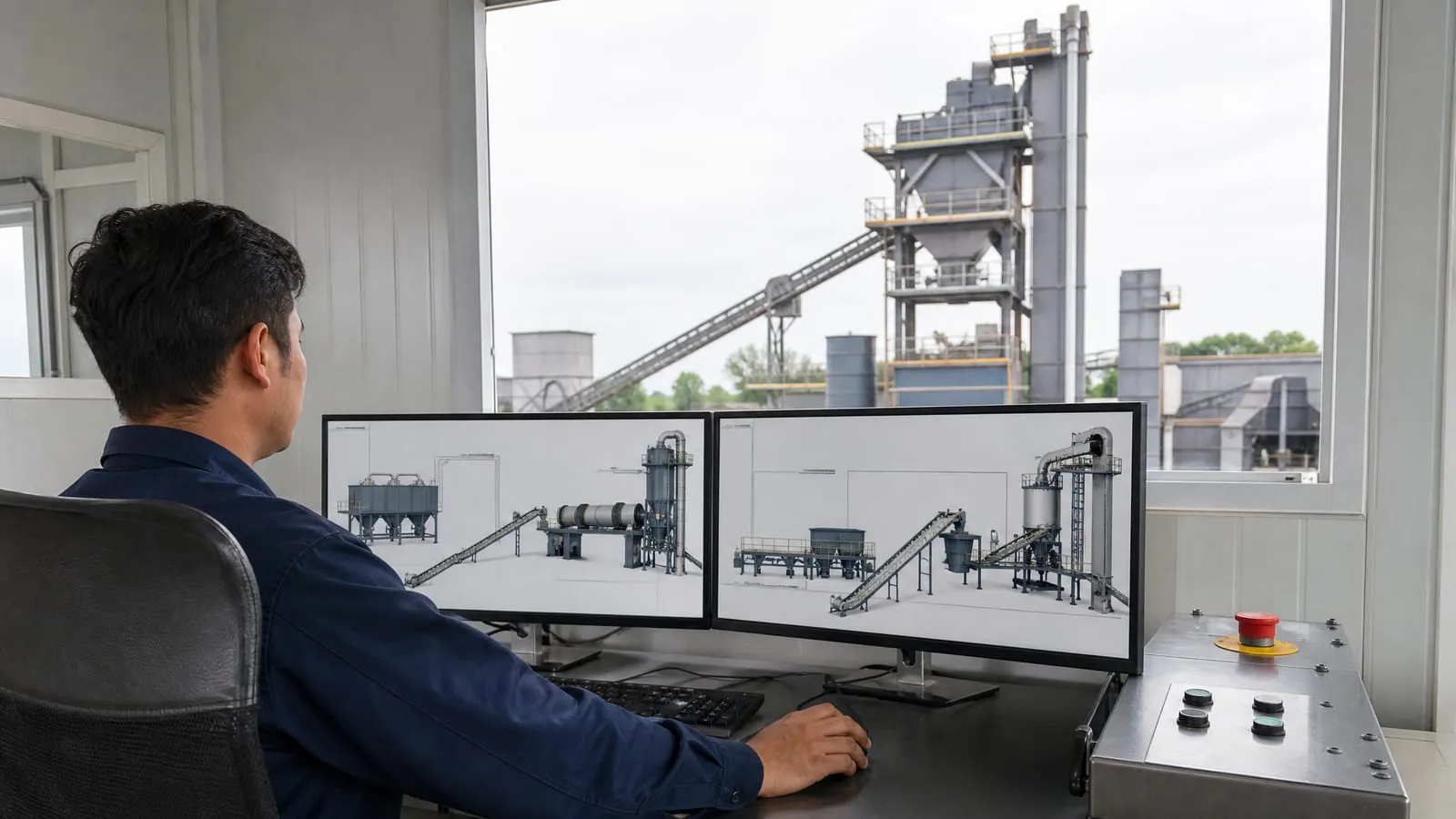
Short answer: The control system runs the start-up sequence, recipes, weighing, burner and temperature control, interlocks and records. Before buying, ask which PLC, scales electronics and software are used, whether spare parts and support exist in your country, and whether it produces batch reports with weights, temperatures and times. Secure remote support lets engineers diagnose faults without travel.
The control system is the plant’s brain. It decides how accurately the plant weighs, how stable temperatures are, how safely it starts and stops, and what records you can show the project engineer.
What the control system does
| Function | What it covers |
|---|---|
| Sequencing | Starts and stops units in safe order; interlocks |
| Cold feed control | Feeder speeds for each bin |
| Weighing | Aggregate, filler and bitumen per batch; tolerances |
| Mixing | Dry and wet mix times; gate control |
| Burner control | Firing rate to hold aggregate temperature |
| Exhaust and baghouse | Draft control; pulse cleaning; temperature limits |
| Bitumen system | Tank temperatures; pump control |
| Alarms | Faults, limits, safety devices; alarm history |
| Records | Batch data, production totals, fuel use |
| Recipes | Store and select mix formulas |
What to check before buying
| Check | Why |
|---|---|
| PLC and electronics brands | Spare parts and local technicians |
| Manual and automatic modes | Keep producing if a sensor fails |
| Recipe capacity and ease of entry | Many mixes; quick changes |
| Batch reports (target vs actual) | Quality records for the engineer |
| Burner control loop quality | Temperature stability |
| Language and units | Operators work in their own terms |
| Alarm history and diagnostics | Faster fault finding |
| Remote support | Supplier engineers can help remotely |
| UPS / power protection | Survive dips; shut down safely |
| Control room climate | Electronics need cooling and dust protection |
Batch records
Increasingly, project engineers want proof of each batch: target and actual weights of every component, temperatures and time. A system that records and exports this saves arguments over quality. Keep records with your calibration file.
Climate and power
Electronics fail early in heat, humidity, dust and unstable power. An air-conditioned control room, sealed cabinets and power protection matter as much as the software — especially in tropical regions and on generator power. See hot and humid climates and the generator calculator.
Remote support
With a secure connection, the supplier’s engineers can view the plant’s screens and alarm history to diagnose problems. Agree who controls the connection and when it is enabled.
Training
Operators learn the control system during commissioning and training. Train at least two people.
Ask about our control system — brands, reports and remote support for your project.