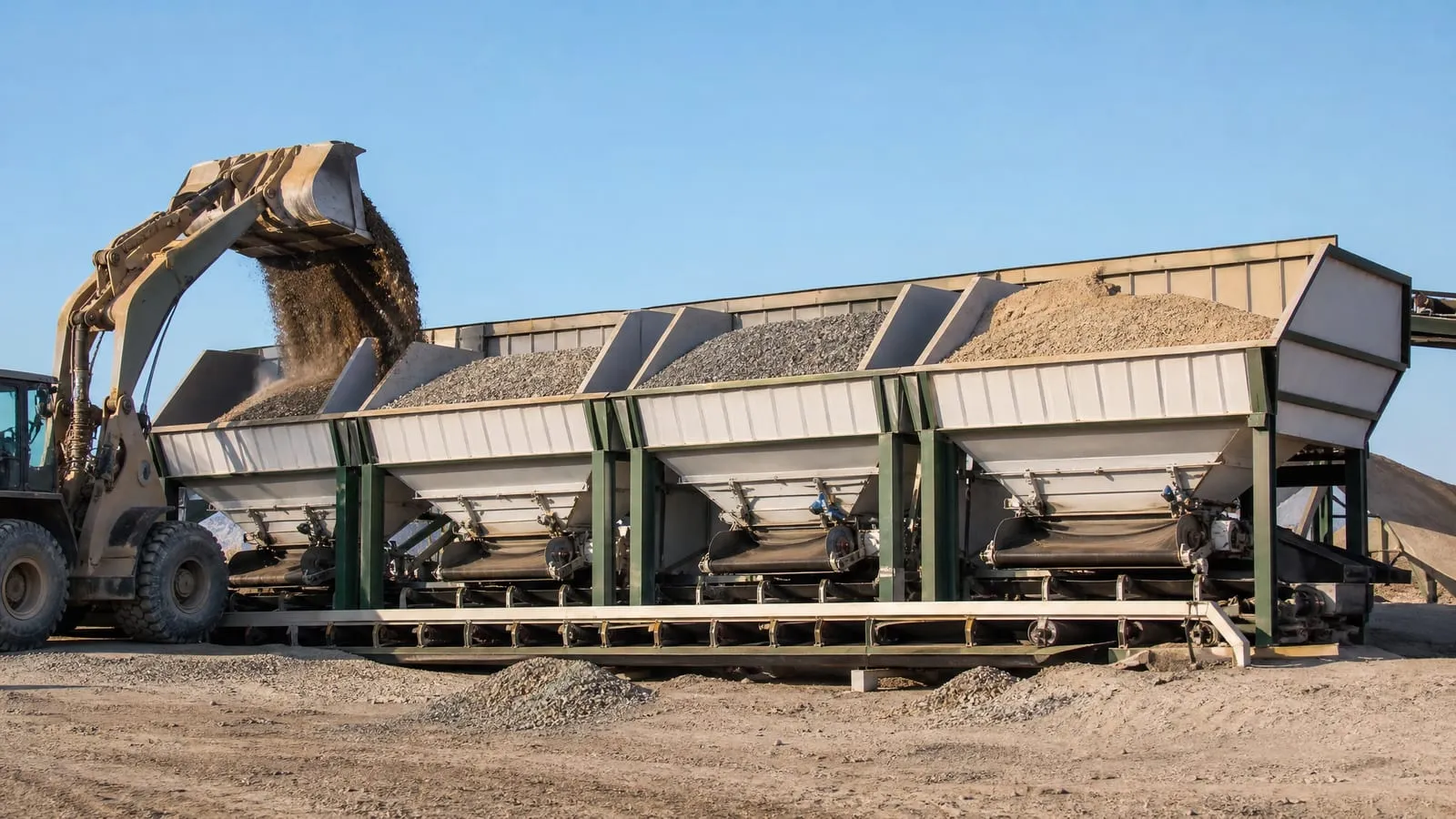
The cold feed system is where every ton of mix begins. It takes each aggregate size from its own bin and sends it, in the right proportion, to the drying drum. In a batch plant the hot screen refines the gradation later; in a drum plant, the cold feed is the only proportioning step.
The parts
| Part | Role |
|---|---|
| Cold bins | Hold each aggregate size; loaded by wheel loader |
| Bin gates | Set the opening height under each bin |
| Belt feeders | Variable-speed belts that meter material out of each bin |
| No-flow sensors | Detect an empty or bridged bin |
| Bin vibrators (sand bins) | Help wet fines flow |
| Collecting belt | Gathers all sizes under the feeders |
| Scalping screen (often) | Removes oversize and debris before the drum |
| Inclined belt | Carries aggregate up to the drum |
| Weighing belt (drum plants, some batch plants) | Measures total flow |
Number and size of bins
| Plant size | Typical bins |
|---|---|
| Small (60–80 t/h) | 4 bins |
| Mid (120–160 t/h) | 4–5 bins |
| Large (240–400 t/h) | 6 bins |
Our RMX-C series, for example, runs from 4 × 8 m³ on the RMX-C80 to 6 × 18 m³ on the RMX-C400. Bigger bins mean fewer loader trips and steadier feed.
How proportioning works
- The recipe gives the share of each size
- The control system calculates each feeder’s flow from the total feed rate
- Calibration curves convert flow to belt speed — see calibration
- Feeders run at those speeds; no-flow sensors watch for interruptions
- In batch plants, hot bin levels show whether cold feed proportions match the recipe — see screen and hot bins
Common problems
| Problem | Cause | Fix |
|---|---|---|
| Sand bin stops flowing | Wet fines bridging | Vibrator; drier sand; cover stockpile |
| Hot bins out of balance | Feed proportions off | Recalibrate; adjust recipe feed |
| Oversize in the drum | Contaminated stockpile | Scalping screen; cleaner loading |
| Belts wandering | Misalignment, spillage | Tracking; clean-up |
Good loading practice starts at the stockpile — see stockpile management.
Back to how an asphalt plant works.